What Is a Better Future?

Walking Backwards Into the Future

Josh Brake

Harvey Mudd College

2025-08-26

What the mission statement does not say

The Harvey Mudd Mission statement:

Harvey Mudd College seeks to educate engineers, scientists and mathematicians well versed in all of these areas and in the humanities, social sciences and the arts so that they may assume leadership in their fields with a clear understanding of the impact of their work on society.


Why doesn’t it say to have a positive impact on society?

History through the lens of a decision tree

A brief history of the lineage of the Large Language Model (LLM).

The big philosophical questions that technology implicitly asks (and answers)

  • What does it mean to be human?
  • What is our vision of the good life?
  • What does it mean for us to become good?
  • Why is the benefit worth the cost?
  • What sort of future do we want?

Technology forms and deforms us and our world

Start also by considering not only what a specific new technology does but also what that technology prevents. Because of that technology, what can no longer be done? Whether it’s road and railway, fax and postal system, computer learning versus other ways of learning, or CD versus book, one has to look both at the enabling and at the foreclosing angle of any way in which things are done. When teaching through new technologies we must highlight not only the skills the new devices bring but also the skills that are not developed because of the use of those devices. It’s often a very real trade-off. The advantages of the new technologies don’t come for free, and the cost is not only in money.

– Ursula Franklin in “Using Technology as if People Matter” (1996)

Innovation always has tradeoffs. We often ignore them.
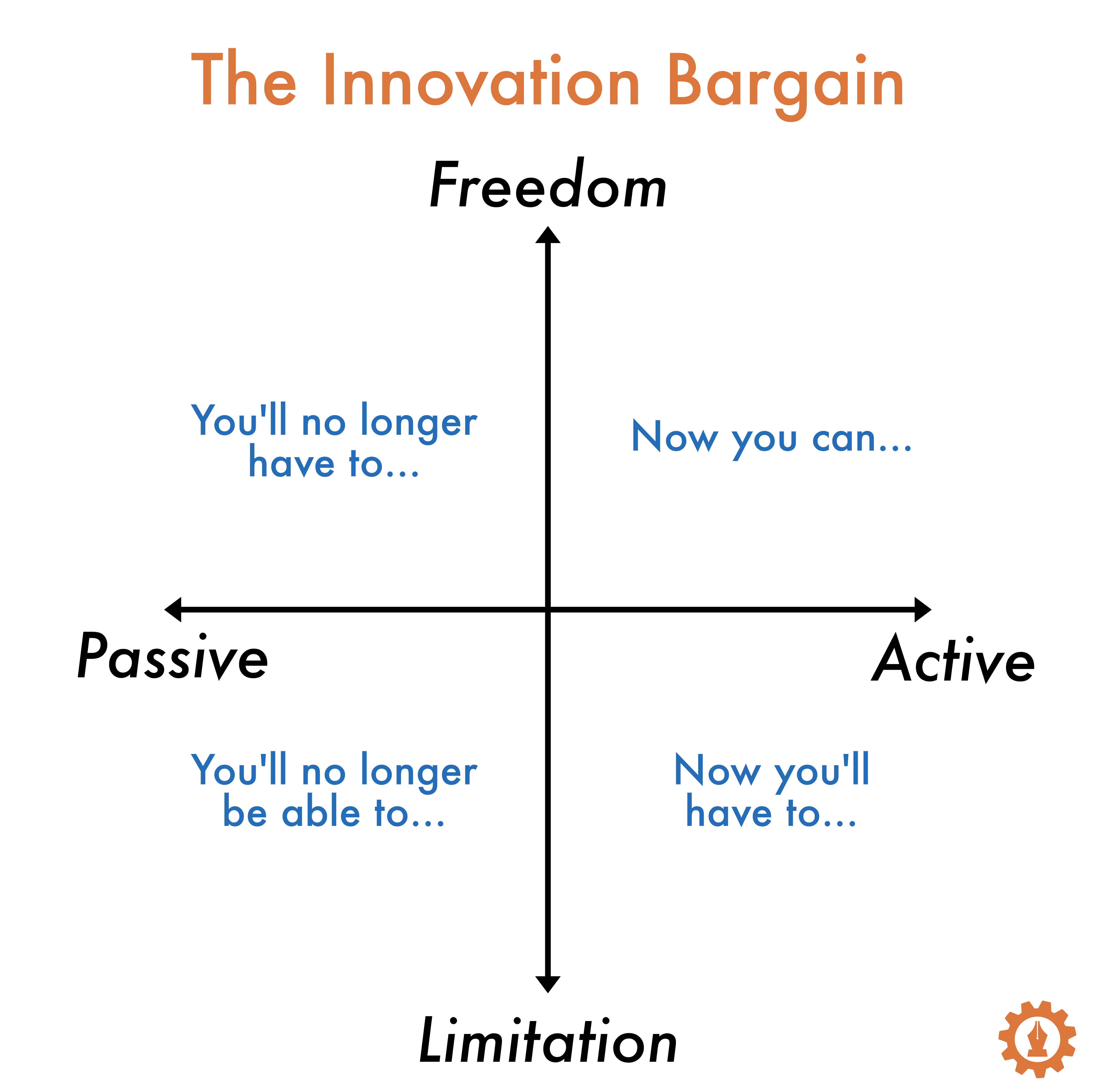
Inspired by Andy’s Crouch’s 2022 talk: “We Don’t Need Superpowers. We Need Instruments.”

We are here to search for and build toward our telos

  • Aristotle: The pursuit of eudaimonia.
  • Nietzsche: No fixed telos at all. Humans should create their own values.
  • Kant: Moral autonomy and every rational being as an end in itself.
  • Transhumanists: Use technology to overcome our limitations.
  • Jesus: Love God with all your heart, mind, body, and soul and love your neighbor as yourself.

These ideas and the questions behind them are the key to understanding what a better future is and how we might get there.

The things we build are motivated by the stories we believe

Consider the science fiction novels that inspire some of the founders in Silicon Valley:

  • Orson Scott Card, Ender’s Game (Sal Khan)
  • Ernest Cline, Ready Player One (Mark Zuckerberg)
  • Neal Stephenson, Snow Crash (Elon Musk)
  • Isaac Asmiov, Foundation Series (Sergey Brin)
  • Spike Jonze, Her (Sam Altman)

We walk backwards into the future

Kia whakatōmuri te haere whakamua - Māori Proverb

“I walk backwards into the future with my eyes fixed on my past.”

The mission of Harvey Mudd College is to cultivate humans

Humans who are…

  • Building practical wisdom
  • Growing in virtue as they foster curiosity, critical thinking, compassion, integrity, and humility
  • Thinking not just about the enabling, but also the foreclosing angles of their work
  • Contemplating the historical and societal context of their work
  • Pondering not just what problems to put their energy toward addressing, but why they are worth acting on in the first place
  • Humble enough to see that having a positive impact on society isn’t quite as easy as it seems

Harvey Mudd College seeks to educate engineers, scientists and mathematicians well versed in all of these areas and in the humanities, social sciences and the arts so that they may assume leadership in their fields with a clear understanding of the impact of their work on society.