The classroom stack gets a name
My classroom AI stack now has a name and a shape: Glassroom. Any instructor can self-host it or deploy it in one click, and a dashboard lets them set the course’s models, instructions, and limits.
// for the classroom
A classroom AI stack you can see through.
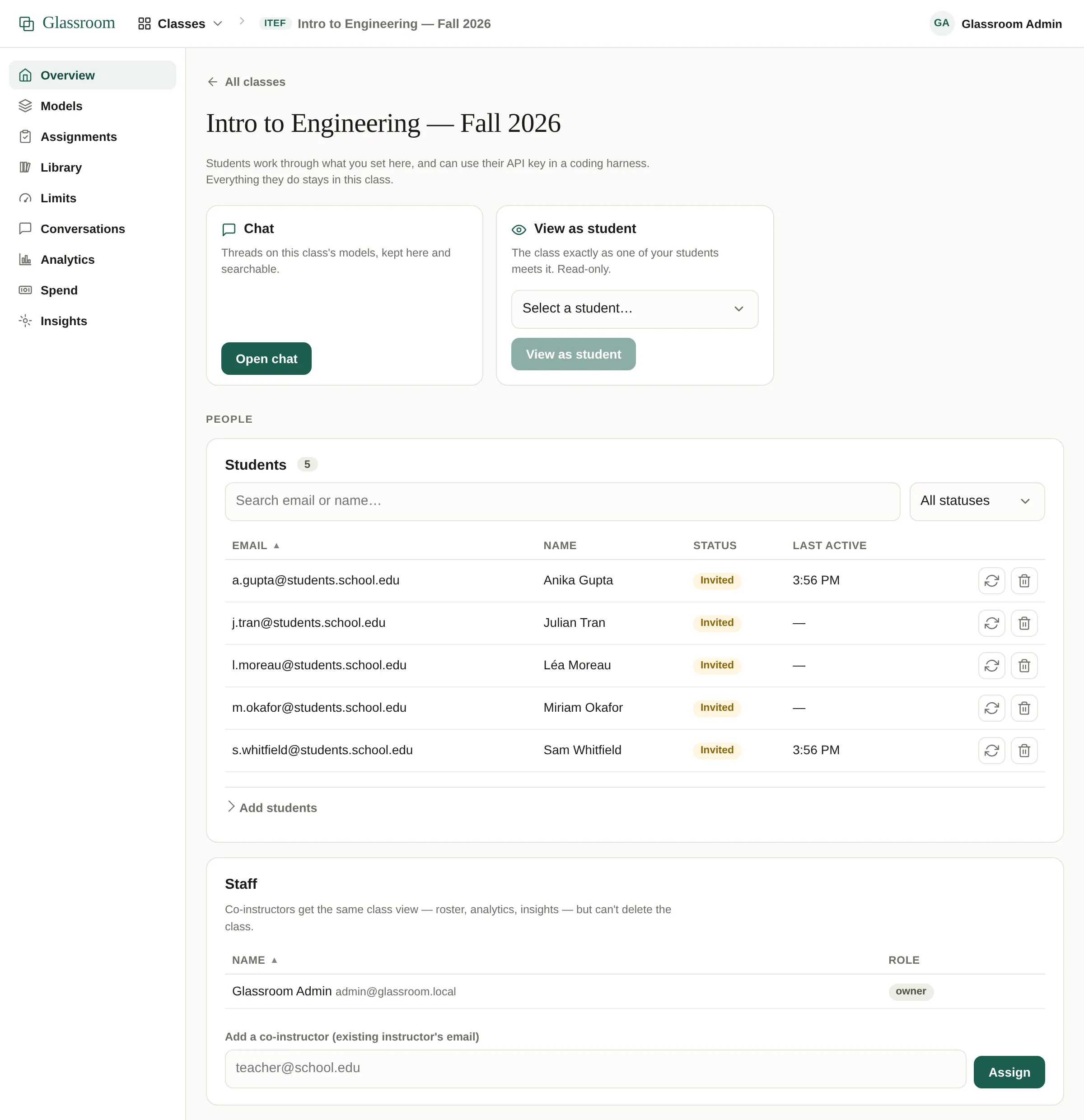
Glassroom gives a course its own AI stack. The instructor picks the models, writes the instructions, and sets the limits, so the AI works the way the course does instead of the way a general-purpose chatbot does.
Every request runs through a single gateway the instructor controls. Students can chat in a clean web interface or point their own coding tools at the same endpoint. Each prompt and response is tied to a student and a conversation, and the record stays on your own machine.
Most classroom AI is a black box: students use it, and nobody, including the students, gets to learn from how it was used. Glassroom treats that record as a shared lab notebook, not a camera in the corner. You can see where a class leans on the model and where it gets stuck, and then bring that back into the room.
It is deliberately not a proctoring tool. There are no detectors and no keystroke logging, and students know the record exists and who reads it.
Glassroom is built on proven open parts: vLLM to serve the model, LiteLLM as the gateway, and Open WebUI for chat, assembled into one stack an instructor can run alone. Host it on a GPU in your own lab and student data never reaches an outside vendor, or deploy it in one click and point it at a hosted model. It’s source-available end to end, so you can read it, run it, and take it apart.
// build log
My classroom AI stack now has a name and a shape: Glassroom. Any instructor can self-host it or deploy it in one click, and a dashboard lets them set the course’s models, instructions, and limits.